harare24dmin
 By Staff Reporter
HARARE – Former opposition leader Nelson Chamisa has publicly drawn a line in the sand, citing “dishonesty and betrayal” as the primary reason for his refusal to reunite with his former high-profile lieutenants.
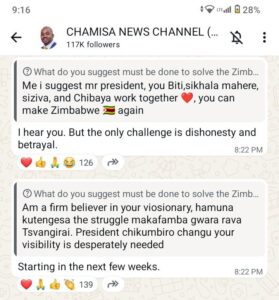
Breaking his long-standing silence on his official Chamisa News Channel (CNC) on WhatsApp, the charismatic leader delivered a stinging rebuke to supporters calling for a “grand coalition” with his former Citizens Coalition for Change (CCC) allies. When a follower suggested a reunion with heavyweights including Tendai Biti, Job Sikhala, Fadzayi Mahere, Gift Ostallos Siziva, and Amos Chibaya, Chamisa’s response was cold and final:
> “I hear you. But the only challenge is dishonesty and betrayal.”
>
This public fallout marks the most definitive sign yet that Chamisa is moving away from the traditional party structures he once led. Since his dramatic resignation from the CCC in early 2024—claiming the party had been “contaminated and hijacked” by the ruling ZANU-PF through proxies—Chamisa has focused on building a “citizen-driven” movement.
The snubbing of Biti and Sikhala, both veteran figures in the struggle for democracy, suggests a deep-seated lack of trust within the upper echelons of the opposition. While figures like Fadzayi Mahere and Ostallos Siziva were once considered his closest confidants, Chamisa’s latest remarks indicate that no one is immune from his current purge of “dishonest” elements.
Despite the internal friction, Chamisa is not backing down. Responding to another follower who desperately called for his “visibility” on the ground, Chamisa issued a bold, time-bound promise that has electrified his base:
“Starting in the next few weeks.”
This timeline aligns with the recent launch of his “Agenda 2026,” a strategic framework he says will tackle Zimbabwe’s governance crisis, corruption, and the “state capture” that has paralyzed the nation.
By shunning his former allies, Chamisa is gambling on a “pure” movement centered entirely on his personal brand and direct citizen engagement. His critics argue that this isolationist approach may weaken the opposition’s collective front against President Emmerson Mnangagwa and ZANU-PF. However, his supporters remain fiercely loyal, viewing the “betrayals” he mentions as the reason for the opposition’s past failures to secure power.
As the countdown to his promised “return to the dance floor” begins, Zimbabweans are left wondering: Can Chamisa truly lead a revolution alone, or has the “dishonesty” he speaks of permanently fractured the fight for change?
Would you like me to analyze the public reaction from Biti or Sikhala regarding these betrayal claims?